
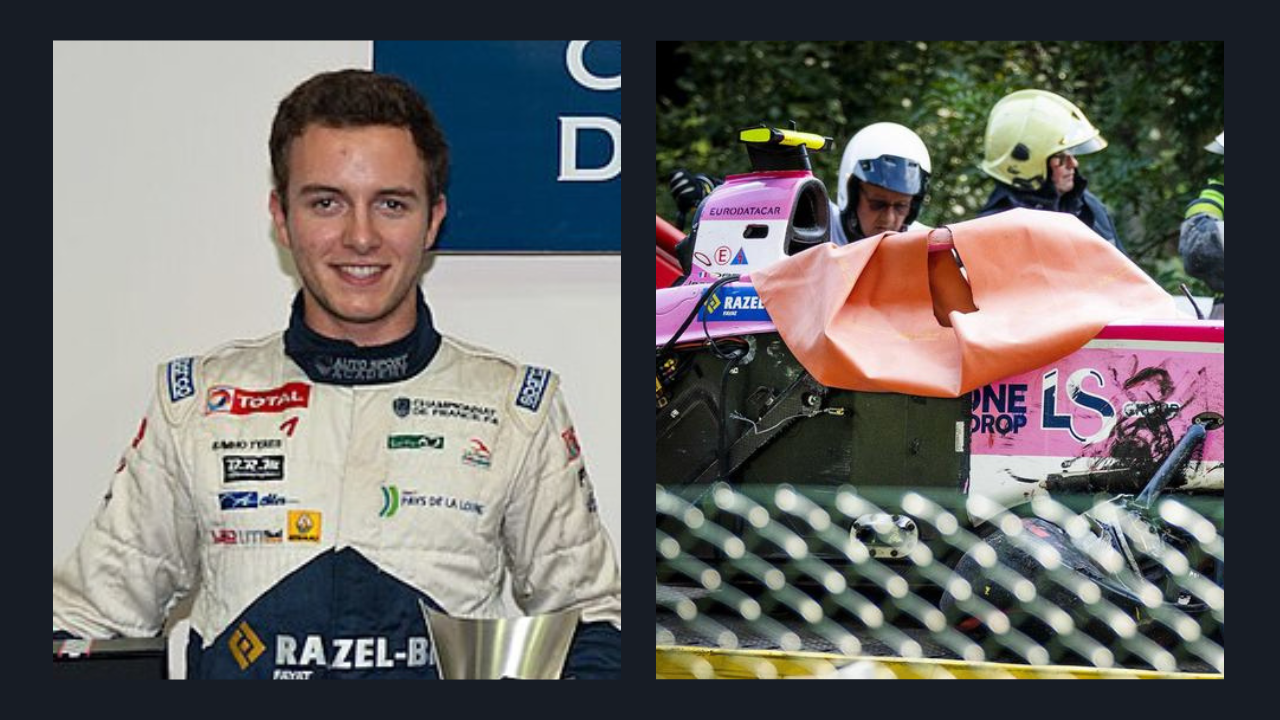
The motorsport community was left reeling on 31 August 2019 when Anthoine Hubert, one of racing’s most promising young talents, was killed during a Formula 2 race at Spa-Francorchamps. Only 22 years old, the French driver had already built an impressive résumé, winning major junior titles and drawing the attention of leading teams across the paddock. His fatal accident, which occurred in the midst of competition, was a stark reminder of the dangers inherent in high-speed racing and prompted renewed reflection on how safety in the sport can—and must—continue to evolve.
This article takes a careful, factual, and respectful look at the crash that claimed the life of Anthoine Hubert. It sets out the sequence of events leading to the accident, examines the injuries he suffered and the damage to his car, and considers the role of safety equipment, including his helmet. It also outlines the conclusions of the official investigation and autopsy, explaining the confirmed cause of death. The goal is not sensationalism, but clarity—to help readers understand what happened and why the incident continues to resonate so deeply within the sport.
Background of the Spa-Francorchamps Race Weekend
The Formula 2 feature race at Spa-Francorchamps has long been regarded as one of the toughest challenges in the series. The circuit’s sheer length, high-speed corners, and dramatic elevation changes demand absolute precision, none more so than through the Eau Rouge–Raidillon section. Cars arrive there at high speed before climbing a blind crest, a moment when visibility is limited, and drivers have only fractions of a second to respond to anything unfolding ahead.
Race day unfolded under dry, late-summer conditions typical of Spa in August. In the opening laps, the field ran nose-to-tail as drivers pushed aggressively to gain track position early. With cars travelling at extreme speed, visibility disappearing over the crest, and little margin for error, the setting was one in which any sudden problem could escalate rapidly into something far more serious.
The Anthoine Hubert Accident: Step-by-Step Breakdown
The accident that claimed Anthoine Hubert’s life developed in a matter of seconds and involved several cars. On the second lap, a driver ahead suffered a puncture while climbing through Raidillon, causing him to lose control and crash heavily into the barriers. The impact scattered debris across the circuit, leaving the drivers with almost no time to respond when they arrived at the scene.
As the pack arrived at the scene at full speed, the rise in the circuit severely limited what drivers could see ahead. One car slowed in time to avoid the wreckage, but Hubert, running close behind, had almost no warning. His car clipped the slowing vehicle, unsettling it instantly and sending him violently toward the right-hand barrier.
Hubert’s car hit the barrier at a sharp angle, taking a heavy impact before bouncing back across the track. The rebound left the car stranded on the racing line. Seconds later, another driver—also caught out by the debris—lost control and slammed into Hubert’s car almost side-on. That second collision was far more violent and ultimately proved to be the critical moment that determined the crash’s outcome.
Anthoine Hubert Car Damage and Impact Forces
Formula 2 machinery is engineered with extensive safety features, foremost among them a reinforced survival cell intended to shield the driver in major crashes. In this instance, though, the forces involved went far beyond the norm. Subsequent data showed that the impact loads on Hubert’s car exceeded what is generally considered survivable in motorsport, underscoring just how extreme the collision was.
The speed and angle of the second impact caused devastating damage to the car’s structure. The collision was so severe that the vehicles were effectively ripped apart, releasing enormous energy through the chassis. While parts of the survival cell remained intact, the sheer magnitude of the impact exceeded the limits of the car’s safety design.
Investigators later determined that the outcome would almost certainly have been the same even if the car had been fitted with safety structures comparable to those used in Formula 1. The conclusion pointed not to a shortcoming in the car’s design but to the crash’s exceptional violence, highlighting just how extreme the circumstances were.
Anthoine Hubert Injuries and Medical Response
In the immediate aftermath of the crash, track marshals and medical personnel were on the scene within seconds. Hubert was quickly removed from the wreckage and taken to the circuit’s medical centre. Despite the speed of the response and the involvement of highly experienced trauma specialists, it was clear from the outset that his injuries were extremely severe.
Officials later described Hubert’s injuries as catastrophic. Out of respect for his family, detailed medical information was never made public. Still, it was confirmed that he had suffered multiple, severe internal injuries as a result of the immense forces involved in the crash. The trauma was so extensive that it lay beyond the reach of even the most advanced emergency medical care.
Around ninety minutes after the accident, Anthoine Hubert was pronounced dead. The news rippled through the paddock and beyond, sending shockwaves across the motorsport world, where many had followed his journey from the very beginning and regarded him as one of the sport’s brightest young talents.
Anthoine Hubert Helmet and Safety Equipment
Modern racing helmets undergo some of the most demanding safety tests in motorsport, designed to absorb violent impacts, prevent penetration, and limit harmful rotational forces to the head. Hubert’s helmet fully complied with all safety regulations and, according to investigators, performed exactly as it was designed to, within the limits imposed by the severity of the crash.
Even so, the forces involved in the crash were far beyond what any helmet could realistically mitigate. The injuries Hubert sustained were not confined to his head but affected his entire body, the result of extreme deceleration and the violent deformation of the car’s structure. Official findings made no mention of helmet failure, and there was no indication that alternative head protection would have changed the outcome.
The crash served as a stark reminder that, while helmets are vital, they represent just one part of a much wider safety framework—and that there are ultimately physical limits to what even the best protective equipment can endure.
Anthoine Hubert Autopsy and Official Cause of Death
A formal medical examination was conducted after the accident, and authorities released only a summary of the findings out of respect for privacy. It was confirmed that Anthoine Hubert died as a result of injuries sustained in the crash that were not survivable.
In medical and motorsport terms, “non-survivable trauma” refers to injuries of such severity that no level of medical care could alter the outcome. In Hubert’s case, the sheer speed of the impact, the angle at which it occurred, and the forces involved combined to produce injuries that went beyond what the human body can endure.
The official determination was that Hubert’s death resulted directly from the injuries he sustained in the crash. Investigators found no evidence of contributing factors such as fire, delayed medical response, or a failure of safety equipment, reinforcing that the injuries themselves were the sole cause.
FIA Investigation and Findings
In the aftermath of the crash, the sport’s governing body launched a thorough investigation into what had happened. Investigators examined video footage and telemetry data, studied the construction of the cars involved, assessed the circuit layout, and reviewed the response of marshals and medical teams. The objective was to reconstruct the sequence of events in detail and determine whether any lessons could be drawn to improve safety further.
The final report made clear that no single individual or group was to blame. Instead, the crash was attributed to a complex sequence of events that unfolded over just a few seconds. Crucially, investigators found no evidence of driver error or procedural failures, reinforcing the conclusion that it was a tragic convergence of circumstances rather than negligence.
The investigation’s recommendations centred on identifying areas where safety could be strengthened, from car design and debris control to improvements in trackside protection. In the years since, those conclusions have helped shape ongoing safety developments across both junior categories and the highest levels of the sport.
Aftermath and Legacy of Anthoine Hubert
In the days that followed, the remaining races scheduled for the weekend were called off as a mark of respect. Formula 2 also chose to retire Hubert’s car number, a symbolic gesture intended to ensure that his name and legacy would remain an enduring part of the championship’s history.
Tributes flowed in from across the motorsport world, with drivers, teams, and fans all sharing their grief. Many remembered Hubert not just for his obvious talent behind the wheel, but for his humility, determination, and the quiet professionalism with which he carried himself—qualities that left a lasting impression on everyone who knew him.
His death has continued to influence how safety is discussed across the sport. Motorsport will never be without risk, but the lessons drawn from Anthoine Hubert’s accident have underscored the need for constant awareness, ongoing innovation, and a deep respect for the dangers drivers accept every time they race.
Conclusion
Anthoine Hubert’s death stands as one of the most heartbreaking moments in modern motorsport. What happened at Spa-Francorchamps was the result of an exceptionally rare and devastating chain of events, producing injuries that were ultimately deemed non-survivable. Even with highly advanced car design, rigorous safety standards, and immediate medical response, the sheer forces involved exceeded what any protective measures could withstand.
By closely examining the circumstances of the crash—from the sequence of events and the damage sustained to the role of safety equipment and the medical findings—the motorsport community has continued to honour Anthoine Hubert’s legacy through a more profound commitment to safety. Though his life and career were tragically short, their impact endures, shaping the sport for years to come.
Read More: NewsDetects.
Add a Comment